• Skip to main content

Bobbi Emel

Palo Alto and Bay Area therapist

  • About the therapy
  • About Bobbi
  • Resources
  • Contact
  • Legal Stuff

Resilience

7 ways to have more gratitude (and 3 times not to be grateful)

November 27, 2013 by Bobbi Leave a Comment

As I write this, we are fast approaching the Thanksgiving holiday here in the States. The season has me thinking about grateful womangiving thanks and being grateful.

It’s pretty well established that gratitude is good for you. Leading gratitude researcher Robert Emmons has found that gratitude leads to stronger immune systems, lower blood pressure, more feelings of joy, and a greater sense of social connection, among many other benefits.

Guess what? One of the other important benefits is – you got it – becoming more resilient.

So let’s take a look at ways Emmons and others say we can generate more gratitude (and times when being grateful isn’t such a good idea.)


1. Stop and smell the roses. No, really. Smell them.

It’s not just the noticing of things we enjoy that creates the most gratitude, it’s the interaction with our senses that tickles our gratitude bone.

Inhaling the sweet scent of a rose, the ch-ch-ch of a sugar packet as you shake it, or the feel of cool water running over your fingertips helps you savor and appreciate your experience.

And now that you’ve smelled that rose, express your gratitude for it and the pleasure it’s given you.


2. Be grateful in a specific way to people.

It’s wonderful to hold gratitude for things such as roses and sunsets. But when it comes to people, it’s even better to be appreciative of specific things.

Tell your partner, “I so appreciate you vacuuming the carpet when I know it’s my job but you saw how exhausted I was from work this week.”

Say to your friend, “Thanks for asking me for coffee today when you noticed I was feeling down.”

Share with your child, “I love how you share your delight in all of these bright stars in the sky with me here tonight!”


3. Think about death and loss.

Okay, this one may not seem like a lot of fun, but it is very effective.

It’s easy for us to take things for granted – weighty things such as our own lives and the lives of people we love and less consequential things like the joys of chocolate or coffee or texting your best friend.

Thinking about your own death or the loss of a loved one helps you become more grateful for the life you have and for the relationships you enjoy.

And it’s not just a theory, says the Greater Good Science Center’s Jeremy Adam Smith.

“When you find yourself taking a good thing for granted, try giving it up for awhile,” he suggests.

Picture not having chocolate or coffee or – heaven forbid! – not being able to text your friend for a week.

Feeling more grateful for those things already, aren’t you?


4. Be aware of ideas of entitlement.

Do you find yourself feeling like people owe you something because you’re “all that and a bag of chips” as one of my clients says?

Robert Emmons writes, “Seeing with grateful eyes requires that we see the web of interconnection in which we alternate between being givers and receivers. The humble person says that life is a gift to be grateful for, not a right to be claimed.”


5. Remember hard times.

As I’ve often written here on Bounce, perspective is an essential tool of resiliency.

It can also generate more gratitude.

Just recalling tough times in your life helps you see that you made it through that period to get where you are today – which is one thing to be grateful for – and hopefully allows you to have some gratitude about where you are right now.


6. Don’t make gratitude a chore.

In an interesting study on happiness and resilience, researcher Sonya Lyubomirsky had one group of subjects write a gratitude journal three times per week and one group journal one time per week.

Who felt happier and more positive after the study? The group who only kept a gratitude list one time per week.

It seems that gratitude can become a chore if you think that you have to write a list more than one time a week.

Maybe you don’t even have to write a list. But you do have to be conscious and intentional about feeling grateful.


7. Graduate-level gratitude.

Dr. Emmons: “It’s easy to feel grateful for the good things. No one ‘feels’ grateful that he or she has lost a job or a home or good health or has taken a devastating hit on his or her retirement portfolio.”

Jeremy Adam Smith writes: “In such moments gratitude becomes a critical cognitive process—a way of thinking about the world that can help us turn disaster into a stepping stone. If we’re willing and able to look we can find a reason to feel grateful even to people who have harmed us. We can thank that boyfriend for being brave enough to end a relationship that wasn’t working; the homeless person for reminding us of our advantages and vulnerability; the boss, for forcing us to face new challenges.”


When gratitude isn’t such a great idea


Amie M. Gordon, writing for the Greater Good Science Center, wisely points out that gratitude isn’t always appropriate.


1. Feeling grateful for someone who isn’t worthy.

Gratitude isn’t going to help in a relationship that is abusive or just plain wrong for you.

In fact, looking for the positive aspects may just keep you in an unhealthy situation for longer.


2. Avoiding problems through gratitude.

Gratitude helps us get our minds more centered and off of the little things that natter at us on a daily basis.

But, if we always “look for the bright side” and ignore the seriousness of an issue, we may very well get ourselves into more trouble than if we take a realistic view of the problem.


3. Minimizing yourself through excessive gratitude.

There are things you do well. Very well, in fact.

Give yourself credit for these things rather than using overwrought gratitude to appear humble. It’s great to give others kudos for their hard work, but don’t forget about your own!


Finally, here’s a great infographic that sums up a lot about gratitude:
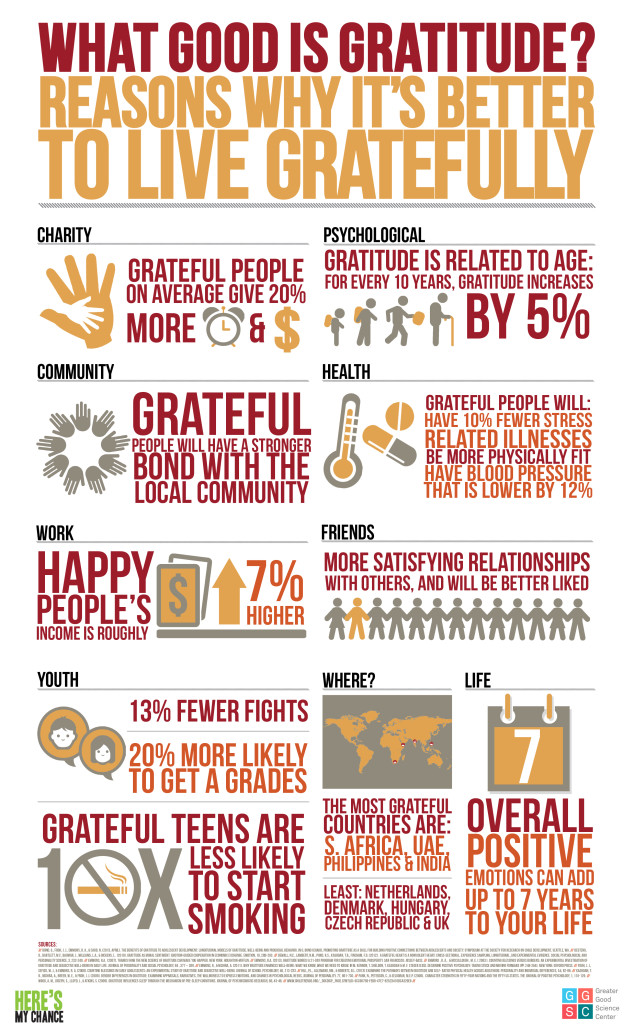


Grateful-Infographic_Final


What’s your take on gratitude? Have you ever used it in an unhealthy way? What helps you remember to be grateful? I want to hear about it in the comments below!


This post is based on several wonderful articles posted at the Greater Good Science Center website:


Six Habits of Highly Grateful People, by Jeremy Adam Smith.

Five Ways Giving Thanks Can Backfire, by Amie M. Gordon

How Gratitude Can Help You Through Hard Times, by Robert Emmons

What Gets in the Way of Gratitude? by Robert Emmons

The Greater Good Science Center is extremely cool. They send out a newsletter every once in awhile that is chock full of positive stuff based on research. I think you should subscribe. (No, I don’t get any kickbacks from the GGSC. I’m just really grateful for the good energy they put into the world.)


I also mentioned Sonya Lyubomirsky (don’t try pronouncing that at home) and this is the reference:

Lyubomirsky, S. & Della Porta, M.D. (2010). Boosting Happiness, Buttressing Resilience: Results from Cognitive and Behavioral Interventions. In J.W. Reich, A.J. Zautra, & J.S. Hall (Eds.) Handbook of of Adult Resilience (450-464.) New York: The Guilford Press.


Infographic courtesy of the John Templeton Foundation.



Filed Under: Resilience Tagged With: grateful, gratitude, resilience

How to bounce back even when you’re exhausted

October 31, 2013 by Bobbi Leave a Comment

“I made a mistake and I’ve been awake the last two nights worrying about it.”cranky bananas

My friend, Valerie, said this the other night as we talked with a woman we consult with, Mary. Valerie made the mistake on an assignment for Mary.

“Oh, Valerie! I’m sorry you were so worried about it,” Mary responded, concerned. “Mistakes happen and I don’t get upset by them – they’re just a part of life.”

Valerie laughed. “I don’t usually get upset by them, either, Mary. I tend to lead a guilt-free life. It’s just that I was so tired and feeling stress from other things that I wasn’t able to get into my Zen place about this mistake.”

Valerie’s words started me thinking.

There are many aspects that can affect our ability to bounce back in life. Some of them are more esoteric, like defining our values and developing meaning in our lives.

But sometimes they are very obvious. As obvious as being physically and emotionally out of gas.


What is PCWT?

Many times I’ve had clients or readers recite a litany of painful emotions and their inability to bounce back, only to have them tell me shortly afterward, “I was really tired and not managing well when I told you all that. I’m better now.”

I can relate to this experience.

Very well.

In fact, I seem to hold royalty in many areas that people struggle with. You might recall that I have previously proclaimed myself the Queen of Tunnel Vision.

I now also proclaim that I am the Queen of Poor Coping When Tired (PCWT.)

When I’m tired, I can’t even find a Mediocre place or a Tolerable place, let alone a Zen place like my friend Valerie.

When I’m on the royal throne of PCWT, mistakes reduce me to tears, problems seem insurmountable, and I get snippy with those closest to me. Just ask my partner.

No, wait. Don’t ask her.


The thief in the night

There are many things that can make us tired, but the biggest culprit is lack of sleep – that wily thief in the night that robs us of our energy.

And what is it about not enough sleep that causes me to be the Queen of PCWT and you, possibly, to be a member of my court?

Part of the problem, scientists say, is that sleeping problems can interfere with rapid eye movement (REM) sleep.

According to Angela Epstein of the online Daily Mail (UK,) “REM sleep is thought to help consolidate memory and emotion, as at this point in sleep blood flow rises sharply in several brain areas linked to processing memories and emotional experiences.”

And in general, the American Psychological Association reports, “. . .  irritability, moodiness and disinhibition are some of the first signs a person experiences from lack of sleep. If a sleep-deprived person doesn’t sleep after the initial signs, the person may then start to experience apathy, slowed speech and flattened emotional responses, impaired memory and an inability to be novel or multitask.”

You can see that we need to sleep so that our brains can complete processes related to keeping our emotions on an even keel and to help us with problem-solving.


You already know this, but here are some resources anyway

I’m not going to go into how to get a good night’s sleep because I’m sure you’ve been inundated with information about it, especially if you have a chronic problem with sleeping.

However, if you’d like more information, this article on WebMD has some good ideas despite it’s overly-cheerful and unrealistic title, Your Guide to Never Feeling Tired Again.

 And you’ll find some reliable information from the American Psychological Association’s fine article, Why sleep is important and what happens if you don’t get enough.

 The solution about getting more sleep is an obvious one and the primary strategy we should use if we’re struggling with feeling tired frequently.


4 ideas to manage your emotions when you’re exhausted

But what do we do when we are tired?

It’s going to happen.

There will be nights that are difficult and stress that will happen and, because we’re human, we inevitably will go through periods of being tired or even exhausted.

What then? How do we maintain our resilience, our ability to bounce back?


1. Recognize that you’re tired.

This may seem obvious, but how many times have you reacted in a way that was out of character only to realize later how tired you were at the time?


2. Notice what is happening emotionally and physically.

 Part of recognizing that you’re tired is being aware of what being tired feels like.

Do you get snappy when you’re tired? Do you become overly sensitive? Do you get irritable and grumpy?

Do you become clumsy? Does your body feel heavy? Do you lose good posture?

Because we tend to live in a state of non-awareness, it’s helpful to start paying attention to what being tired feels like both emotionally and physically.

Once you understand what your body and mind do when they become tired, you’ll be better able to quickly identify that your energy is lagging and take steps to moderate your behaviors: responses to others, decision-making, thoughts about yourself, and so on.


3. Make an action plan for when you’re tired.

 An action plan sounds kind of tiring, doesn’t it?

Here’s what I mean when I say action plan: Now that you’ve recognized your tired, you need to have a plan in place that will allow you to manage emotionally and behaviorally during that time frame.

So, my action plan looks something like this:


  • Recognize that I’m tired.
  • Be cognizant of the fact that I get overly sensitive, snippy, and have problems making decisions.
  • Put off making important decisions if I can.
  • Pause before responding if I’m feeling a snippy remark coming on. (This is hard and I don’t always accomplish it.)
  • If I feel hurt by another person’s remark, set it aside to reconsider when I have more energy.
  • Apologize when necessary.
  • Take a nap or make a plan to recharge.


4. Apologize when necessary.

 Yes, you already saw this in my plan of action. I’m repeating it because it’s an essential part of bouncing back when you’re tired.

If you make a mistake or hurt someone’s feelings or act out of character when you’re tired, apologize.

Addressing the issue right at the moment it occurs will keep it from expanding out of control and will put you in good stead to bounce back into your Zen place.


Where do you stand in my royal court of Poor Coping When Tired? And what’s your action plan? Let me know in the comments below.

Then . . . go get some sleep.


Filed Under: Resilience

Tunnel vision? 5 ideas to help you see the light

August 16, 2013 by Bobbi 4 Comments

I am the Queen of Tunnel Vision.tunnel vision

Case #1:

I want to find a branch of my bank near where I’m running errands, so I pull into the parking lot of a small shopping mall and consult my smartphone. It gives me an address that seems very close.

I pull out onto the street, make a u-turn to go in the direction I think the bank is, and as I pass by the shopping area where I was parked, I see the bank in the same parking lot.

It was directly behind where I had been parked, but because I was focused on finding the nearest bank, I didn’t look where I already was.

Case #2:

I’m at the gas station and I want to use my fuel rewards/grocery savings card to see if I can get a discount on gas. I shoot my card in and out of the slot quickly, only to see the display tell me that my card isn’t registering.

I know the magnetized stripe on this card has not worked in the grocery store slots, either, and I always have to ask the cashier to scan it for me.

Nonetheless, I continue to pop it in and out of the slot at the gas station, hoping the reader will be different than the ones in the grocery store.

No luck.

I insert the nozzle and start pumping gas at the regular price. I look around idly and my eyes fall again on the gas pump.

This time I see it. About twelve inches to the left of the card-reader slot is a scanner with a sign that has a large arrow pointing to the words, “Scan your fuel rewards card here!”

Sigh.

I was so focused on the card-reader slot and only the card-reader slot, that I was not able to see anything else on that pump.

I rest my case for being the undisputed Queen of Tunnel Vision.

Tunnels make you miss the light

Although these incidents are harmless and give me some amusement at my own expense, they also serve as a good reminder for me to be more aware of my tunnel vision syndrome. If I do it while looking for a bank or pumping gas, it’s quite possible I’ll do the same thing when a much wider perspective is needed.

When a problem arises or one of life’s storms blows in out of nowhere, having an extremely narrow view tends to keep us locked in on one component of it.

For example, when my late partner was diagnosed with cancer, my first reaction was to focus intensely on the cancer itself. What was it? How could we cure it? What were the best things for Ruth to eat? What was the most effective treatment?

These were all good questions to ask, but if I had remained fixated on only the disease itself, I would have missed something very important: the journey that surrounded the disease.

It was Ruth who first gave me the nudge that widened my vision. One day at a bookstore, she held up a book by Lawrence LeShan called Cancer as a Turning Point and said, “I think this is the answer. We should take a spiritual approach to my cancer. We don’t need all of these other medical books.”

That simple shift in focus brought many wonderful experiences to us. With our eyes off the cancer and looking about us, we noticed how many people truly loved us.

We saw the miracles that occurred each day in the ordinary: the flight of birds in the sky, the simple pleasure of friendship, the joy of laughter between us.

There were times when tunnel vision returned. When Ruth became very sick from her treatment, it was hard to focus on anything other than how to get her better. But even then, we learned to allow a simple, loving email from a friend to gently jar us loose from our fixed view and remind us that when life is at its hardest, there is beauty and love on the fringes.

Widening your view

If you’re a member of my Royal Court of Tunnel Vision, here are some ideas on how to broaden your view:

1. Notice when you are in the tunnel.

This takes some practice, but the next time you find yourself stuck on a problem – whether it’s where to put your fuel rewards card or figuring out how you’re going to pay your mortgage next month – stop for a moment. Ask yourself, “Am I entertaining all solutions or am I stuck on just one? Do I need to step back and look around me? How else can I think about this?”

2. Practice looking at things from another vantage point.

I love to read self-help books and I was completely caught off guard a couple of years ago when I decided to read Roger Van Oech’s A Whack on the Side of the Head: How You Can Be More Creative.

I don’t know what possessed me to read it since it wasn’t technically “self-help,” but I’m forever glad for that possession because it has turned out to be an invaluable asset. Through games, puzzles, and stories, it teaches you to look at life from a different angle.

I had innumerable “Oh, I get it!” experiences that not only made me see how very narrowly focused I was, but also gave me tools and ideas about how to widen my approach to everything from word puzzles to life problems.

If you can’t read the book, practice opening your viewpoint with these activities:

–        When you’re in your car at a stoplight, look around you rather than at your smartphone or radio. See what is next to you on either side and then look all the way behind you.

–        Try a few crossword puzzles. Crossword clues are intentionally designed to fool you by using words that usually mean one thing but can mean another. For example, the answer to the clue, “Render powerless?” is unplug. The answer to the clue, “Pain in the rear” is backseat driver. Get it?

3. Ask others for help.

When we are in the tunnel, it’s easy to think that it makes up our entire world. All we see and know is the dark, curved walls around us.

Maybe we need a little light to help us see that we’re in a tunnel, not in the real world. A friend can do that for us. Ask a friend to help you brainstorm ideas and solutions for the problem you’re facing. The old saying, “Two heads are better than one” is quite true in this case.

4. Look where you already are.

Sometimes we have what we need around us and we can’t see it. Just like when I was sitting in my car but never saw the bank right behind me because I was too focused on my smartphone.

Take a deep breath and look around you. Is there someone who can help you navigate this storm in life? Have you made it through darkness before and can use those same skills and attitude now? Is there still faith within you that there is a light at the end of this tunnel?

5. See if there is something on the fringe you are missing.

Just as Ruth and I found beauty and love on the fringes of her cancer, see what you can find around your problem. The only thing you’ll find in a tunnel is darkness.

Look for the light, my friend, look for the light.


How about you? Are you a member of my Royal Court of Tunnel Vision? What helps you to expand your view?

Let me know in the comments below!

Filed Under: Perspective Tagged With: light, perspective, tunnel vision

Getting on with life despite devastating emotions

July 22, 2013 by Bobbi 6 Comments

When I receive emails from people who are in crisis, most of the time they want to know how they can get rid of the painful emotions they are experiencing.

Drop the rope
Drop the rope

“My son has been arrested for dealing drugs, and I had no idea he even knew about drugs! I’m embarrassed, shocked, ashamed, and angry. How do I stop feeling this way so I can get on with my life again?”

“My wife died two months ago and I’m still overwhelmed by sadness. I feel like I’ve lost my way in the world. How do I move through grief faster so I can have a life again?”

The assumption implicit in these questions is, “Painful feelings are bad and I need to get rid of them as soon as possible in order to get on with life.”

Because of this assumption, we may try to get rid of our feelings in a variety of ways: avoiding them, suppressing them, resisting them, or wishing they would hurry up and be over. This effort is a natural thing to do, since nobody likes pain.

The problem is that all of those resistance activities, while they might work in the short run, may magnify the feelings overall. There are two parts to this magnification mechanism:

1) The more we try not to think about something (“I’m not going to think about my grief,”) the more we think about it; and,

2) Because we are thinking more about the painful feelings, we may start to add to them with thoughts such as, “This is the worst pain ever. I can’t stand this.”

Dropping the rope

Russ Harris, author of The Happiness Trap, likens this process to being in a tug-o-war with a monster who is trying to pull you into a pit. You pull as hard as you can against the monster of your painful feelings, only to find that the monster grows stronger each time you pull. What should you do? Pull even harder?

How about if you drop the rope?

This does not mean you give up and don’t take action when it is necessary. This is about letting go of the resistance to your painful feelings so they don’t pull you further into a pit.

Finding out your son is a drug dealer and losing your wife to cancer are life-shattering events. Painful feelings are sure to arise. Allow them to do so.

And, take action when it is needed.

Perhaps you’ll want to learn more about drugs and addiction so you’ll know how to best help your son. Maybe you’ll want to join a grief group or see a therapist for support during your time of mourning.

The bottom line with life-altering traumatic events, as well as merely stressful everyday events, is that we may get too caught up in our minds with the negative thoughts and in our hearts where the painful feelings roil and stew.

With both severe and moderate crises, we can “drop the rope” by acknowledging that our thoughts aren’t particularly helpful right now and letting them go by, like leaves floating on a stream, and by allowing our feelings to just be rather than trying to get them to stop or leave.

By not resisting our experience, we may have access to more inner resources to creatively approach the problem facing us and take an active approach to solving it or figuring out a way to make it through a particularly difficult time.

What are your thoughts about these ideas? Is it hard to separate taking positive action from using negative avoidance strategies?


This is the last in a four-post series about learning to live a rich, meaningful, values-based life despite the challenges that life inevitably brings us, be they everyday annoyances or full-scale disasters. If you missed the first three posts, check them out here:

How to live a more meaningful life: An open invitation

Naming your values: The compass for a rich, meaningful life

How to manage your emotional demons


For a great read on this topic, check out Russ Harris’ The Happiness Trap: How to Stop Struggling and Start Living: A Guide to ACT.

Therapists, life coaches, and counselors may be interested in ACT Made Simple: An Easy-To-Read Primer on Acceptance and Commitment Therapy.


Filed Under: Resilience Tagged With: acceptance, negative feelings, painful emotions

How to unhook from negative thoughts

June 2, 2013 by Bobbi 33 Comments

Which of the following sounds better to you?self talking

A. “I go to this job because there’s no way anyone would hire me somewhere else.”

B. “I go to this job so I don’t have to put up with my husband hassling me about money all the time.”

C. “I go to this job because it helps me contribute to society, enjoy connections, and create community.”

Option C is obviously the most appealing choice. That’s because it’s based on values: contributing to society, enjoying connections, and creating community.

Much like a compass gives direction to travelers, values are the principles that we use to guide our lives.

Or do we? In my last post, I shared how easily I slipped back into old habits, and despite how much I value connection and community—which I find through interacting with you—I let a month go by before continuing our conversation about experiencing a richer, more meaningful life through aligning our behavior more closely with our values.

Slipping back into old habits is one way that we sometimes get away from value-based living. There are two more ways that we’re going to look at in this post and the next: getting hooked by our negative thoughts and getting hooked by our painful feelings. First up: negative thoughts. [Read more…] about How to unhook from negative thoughts

Filed Under: Perspective, Resilience

How do we recover from the Boston bombings?

April 17, 2013 by Bobbi 26 Comments

So, here we are again, talking about yet another atrocious attack on innocent and unsuspecting Americans.hands together

Three people are dead – including an 8-year-old boy who was watching his dad finish the Boston Marathon – and more than 150 people have been injured in the twin bomb blasts that occurred at the finish line of the iconic event. Several of the injured people are in critical condition. Some of the people near the blast zones had limbs amputated.

Once again, we ask ourselves, “How do we bounce back from this?”

Here’s how we do it:

We remember that Americans in general, and I believe, Bostonians in particular, are a naturally resilient lot. We have an innate chutzpah that brings us back from tragedy.

We rely on each other. Just as medical personnel and bystanders alike rushed toward the blasts to help, we reach out to each other for comfort and support and a safe place to vent our anger.

We refuse to be terrorized. Kevin Cullen of the Boston Globe said, “This is a very tough town. We take only three things seriously here, and that’s sports, politics, and revenge. And the best revenge is the smiles of our children.” We carry on, our hearts heavy, but with the sheer determination to claim this country and the communities within it as our own. Communities that create the places where children continue to laugh and play.

We help. Someone from Arkansas called up a pizza restaurant in Boston and gave a donation so that the runners and other people dislocated due to the bombings could be fed while waiting to be reunited with their families. A pet hotel owner outside of Boston offered free board and care for the pets of first responders who had to work extra shifts.

We take responsibility seriously. “These are the times that try men’s souls,” wrote Thomas Paine in 1776. Each generation since can probably attest to the truth of these words as it points to one horrendous act or another. With the ease of finding information that promotes evil via the internet, our generation is faced with an abundance of people who can effortlessly and severely harm us. We must take responsibility for each other. This is not just a catchphrase, it is a call to action that each of us need take seriously, “If you see something, say something.”

We love. If you light a candle in a dark room, the darkness disappears. The light is not swallowed up by the dark. The light in our humanity is love. Remember to be loving. Remember to be kind. Remember to help. Remember that we are all connected.

We will not be terrorized.

We will bounce back.

We will love.Boston


What are your thoughts about terrorism in America? How do we help each other bounce back? You know my ideas and now I want to hear yours. Let’s talk about it in the comment section below.

Filed Under: Resilience

How to live a more meaningful life: An open invitation

March 19, 2013 by Bobbi 83 Comments

I invite you on a journey.You are invited

I am on a path to make my life more rich and meaningful, and I encourage you to come along with me.

Because I’m approaching my 50th year, I find myself wondering about my place in the world. What is my purpose here? What will my friends and family say about me and my life when my life is over? Will I have an impact?

This musing leads me back to one question: What am I doing? When I answer this question, I feel a bit unsettled.

I’m starting to understand where my discomfort is coming from.

The treadmill

Like many people, I sometimes think, “When ______ happens, I’ll feel better, or my life will be good, or I’ll have ‘arrived,’ or I’ll be happy.” I set goals I want to accomplish so that any or all of those results will occur. And when I reach those goals, I do feel better!

But after a while, the luster fades, and I’m back to thinking, “When _____ happens . . .”

It’s a kind of treadmill. Researchers call it the hedonic treadmill (also known as hedonic adaptation). This is the process most of us experience when we adapt quickly to a new element in our lives. If my goal is to get a new bicycle and I achieve my goal, I’m thrilled with my new bike! But after a few weeks, I adapt to the new bike that has entered my life, and I return to my pre-bike-acquisition emotional state.

I am back on the treadmill, aiming for my next goal. The familiar question looms in front of me: What am I doing? And why?

The missing piece

I’ve been studying a type of therapy known as Acceptance and Commitment Therapy (ACT). I’m beginning to answer those questions in a way that eases my discomfort and leads me forward on the path to that richer, more meaningful life.

ACT is about accepting what we can’t control and committing to taking action. It encourages us to reflect on what we’re doing and why we’re doing it: this process helps me to understand what I’ve been overlooking in my life.

The component that I’ve been missing recently is values. Not that I don’t have any; I have numerous honorable values. But, I do not always allow them to be what my life is about. When I think about it, the most treasured times in my life have been centered on my values.

Many years ago, my partner at the time, Ruth, had metastatic breast cancer. You might think this was the worst time in my life. But it wasn’t. It was one of the best times in my life. When I look back, I see that those years were extraordinarily rich and filled with meaning. Ruth said in all sincerity that she would not have traded away her experience with cancer. And I felt the same way.

Why? Because we chose to live according to our values. We had a goal for Ruth to live as long as possible with her terminal illness, but the key was how we lived our life together during that time. We learned the art of nonresistance along the way, and so we valued acceptance. We accepted Ruth’s cancer along with the other ups and downs that come along in life.

We valued honesty and intimacy. We had many long, fruitful, cherished discussions about death, dying, and how to live our best lives. No topic was off limits. Our conversations wove a deep emotional tapestry of our relationship.

Because we knew our time together was limited, we valued being as present as possible with each other and in the world. People who experience life-limiting illnesses often say, “Colors seem more vivid, aromas smell better, and chirping birds sound like music.” I can testify that is true! Living fully in the moment does, indeed, bring more texture and brilliance to life.

I understand now that living according to my values was the essential factor that made my experience during that time so rich and meaningful. It wasn’t about goals or any thought that started with, “When _____ happens . . .”

Come with me?

I am on this path toward living a richer, more meaningful life. I’m not saying I want to live a stress-free always-happy life. I want my life to be purposeful, even when I’m struggling with sadness and depression. I want to keep meaning and intention in my awareness when things are going well and when life sucks. I want my answers to the questions, “What am I doing? And why?” to be aligned with my values.

Will you come with me?

Many of you have written to me telling me about your struggles in life, and in your stories I hear echoes of my own experiences. “If only I didn’t have depression/worries about my child/a broken heart/anxiety/lack of confidence/financial problems—I’d feel better.”

But what if you could lead a life full of purpose and meaning with those challenges? What if you could say, “I may be struggling right now, but I still know who I am and what I stand for, and I will act accordingly?”

I invite you to travel this path with me.

Will you come?

Let me know in the comments below.


We will delve more deeply into this topic in the following posts. Next up: What are values? What’s the difference between goals and values? And, how do I determine what my values are?

In subsequent weeks, we’ll discuss obstacles to living a values-based life and how we can learn to accept things that are out of our control in a gentle yet active way.

Recommended reading: The Happiness Trap, Russ Harris.

Filed Under: Resilience Tagged With: meaningful, purpose, values

55 ways to bounce back from (just about) anything

February 9, 2013 by Bobbi 29 Comments

Our greatest glory is not in never falling, but in rising every time we fall. ~ Confucius

recovery chalkboard


By now, you know how life works.

We stand up and we fall down again, just like a toddler learning how to walk.

There are many ways to pick yourself back up and I’m presenting you with 55 of them to get you started.

Use one or two that you like the most or mix and match to your heart’s content.

Text in this color means that it is linked to a helpful article on that topic so make sure to check it out.

Okay, go get your bounce on!


1. Accept the reality of your situation. Face the facts – it’s happening.

2. Realize that change is always going to be in your life. Expect it.

“I always thought things would calm down and get easier. I’m beginning to think that’s not going to happen.” Phoebe Howard, age 99.

3. Learn to be an optimist.

4. Be nice to yourself. Treat yourself as you would your best friend.

5. Remember that everyone has flaws. Everyone. You’re a part of the human race so you’re bound to make mistakes.

6. Practice mindfulness by noticing your thoughts and feelings, but have no judgment about them.

7. Resistance is like a Chinese Finger Trap. The more you struggle, the tighter you’re held in the trap.

8. Be flexible and open in your way of thinking. It will allow you to problem-solve more effectively and accept your reality more easily.

9. Have a tribe. Social support is absolutely essential in bouncing back in life.

10. Talk about your difficulties with trusted friends and family members. You don’t have to tough it out. Talk it out instead.

11. Let go of judging your thoughts and feelings. Just notice them. Read Taming Your Gremlin.

12. See if there is a gift hidden within your troubles. The sand that irritates the oyster eventually becomes a pearl.

13. Develop post-traumatic growth. The basics are being optimistic and framing your struggles as meaningful (finding the gifts and opportunities in them.)

14. Look at problems from different angles.

15. Remember that you’ve made it through tough times before. And you’re still here to talk about it.

16. Instead of wasting energy resisting what’s happening in your life, accept what is and use that energy to enjoy the good things in your world.

17. Think about kaleidoscopes. The pattern is beautiful, but when it gets shaken up, a wonderful new pattern can emerge.

18. Take a break.

19. Find something that makes you laugh really hard.

20. Have a mentor. Find someone you trust and admire and use them as your go-to person for advice, support, and guidance.

21. Remember that your thoughts aren’t always true.

22. Remember that it’s okay to have fun, smile, and laugh sometimes even when you are in the worst of situations.

23. Just because you struggle with something doesn’t mean you’re not resilient. It means you’re human.

24. Everyone makes mistakes. Everyone.

25. Sometimes things really do suck. No one said you have to like the difficulty in front of you.

26. Look up. Get out of your head and actually look up from time to time. What do you see that you didn’t notice before?

27. Create positive emotions.

28. Get a new perspective.

29. Practice acts of kindness.

30. Once a week, write down what you’re grateful for.

31. Take action to solve the problem rather than just ruminating about it.

32. Stop ruminating.

33. Savor the good stuff. The next time you see a beautiful sunset, stop and really see it.

34. Don’t resist.

35. Drop your struggle against change. We want to feel like we’re flexible and open and yet, when change arrives, we resist it as though it were the devil.

36. Do what is in front of you.

37. Embrace your shadow. We all have a dark side – don’t run from yours.

38. Remember that falling apart means you can put yourself back together any way you’d like.

39. Express yourself. Don’t try to stuff your negative thoughts.

40. Focus on the positive rather than predict the negative.

41. Have mercy on yourself.

42. Distract yourself from your troubles for awhile. Healthy stuff only!

43. Manage your Inner Critic.

44. Remember that this is how it feels today. It won’t be like this all the time.

45. Get over fear of failure.

46. Remember that Suffering = Pain x Resistance.

47. Adopt a growth mindset rather than a fixed mindset. See failures as opportunities to learn rather than unmanageable setbacks.

48. Believe that life is meaningful. “Those who have a ‘why’ to live for can bear with almost any ‘how.’” Frederich Nietzsche.

49. Don’t take things personally. That’s what pessimists do. You’re trying to be an optimist, remember?

50. Increase your creativity to be able to improvise solutions better. Read A Whack on the Side of the Head.

51. Be willing to grow.

52. Let it go.

53. Stay away from shame. Watch Dr. Brene Brown’s Tedx talk.

54. Change what you can, accept what you can’t.

55. Breathe.


Which of these works best for you? Or do you have other ideas that I may have missed?


If you enjoyed this post, please ‘like’ it on Facebook and/or give it a Tweet! Thanks!


And don’t forget to subscribe to Bounce by filling out the short form above on the right. You’ll also get my FREE ebook Bounce Back! 5 keys to survive and thrive through life’s ups and downs.

Filed Under: Resilience

  • Page 1
  • Page 2
  • Page 3
  • Interim pages omitted …
  • Page 6
  • Go to Next Page »

Copyright © 2026 · Infinity Pro on Genesis Framework · WordPress · Log in